
Chapter 1: Substance Classifications and Professional Practice
|
Chapter 1 — Module 1: Foundations From Categories to Care: Building the Foundation Developing a shared language and grounded professional stance for understanding substance use across systems and contexts. |
Chapter 1 introduces the conceptual and professional foundation on which the remainder of the course rests. Before moving into the scientific or diagnostic dimensions of substance use, students must first develop a shared language and a grounded stance that shapes how the issue is understood in practice. Substance use is often interpreted through frames that reduce complexity, limiting critical inquiry and pushing broader social conditions out of view. This chapter establishes how substances are defined within legal systems and how patterns of use become visible through population data, while positioning professional practice within an interprofessional context that reflects the realities of care.
Substance use does not emerge within a single domain, and it is not resolved through isolated intervention, which means professional roles are always in relation to one another, whether that connection is intentional or not. These elements are not neutral. They shape how problems are defined and how responses are justified, particularly through the language professionals use and the assumptions that language carries. Attention to stigma becomes essential at this stage, as the terms used to describe substance use can reinforce judgment or support understanding in ways that directly influence practice.
The chapter moves through three connected parts. It begins with how substances are classified and how patterns of use appear in population data, turns to the professionals who respond to substance use and how their roles fit together, and closes with the language and self-awareness that shape ethical practice. This order is intentional, building from what substance use is, to who responds, to how professionals think and speak about the people they serve. The aim is to develop a way of thinking that remains attentive to context and responsive to the interconnected nature of practice, so that later learning is grounded in a clear and purposeful professional perspective.
Student Learning Outcomes
This chapter supports the following course objective. By engaging with the material, students will work toward the ability to:
Apply ethical standards, professional values, and communication skills to engage individuals, families, and communities affected by substance use and misuse, demonstrating an understanding of the neurobiological and biopsychosocial foundations that inform professional practice.
| • | Recognize how substances are classified and how patterns of use become visible through population data. |
| • | Describe how professionals across disciplines work together within an interprofessional model of care. |
| • | Examine how professional language and personal assumptions shape ethical, respectful practice. |
Council on Social Work Education (CSWE) Competencies Addressed
Competency 1: Demonstrate Ethical and Professional Behavior
Competency 2: Advance Human Rights and Social, Racial, Economic, and Environmental Justice
Competency 3: Engage Anti-Racism, Diversity, Equity, and Inclusion (ADEI) in Practice
Competency 6: Engage with Individuals, Families, Groups, Organizations, and Communities
A Note on Terminology
Throughout this textbook, the term substance use is used as a broad, inclusive way to discuss alcohol and other drugs. This choice is intentional. More specific terms such as substance misuse, addiction, alcohol use disorder (AUD), and substance use disorder (SUD) are used when they are clinically or conceptually appropriate, but substance use serves as the general reference point for the wide range of experiences, behaviors, and outcomes connected to alcohol and other drug consumption.
Using the broader term allows the book to discuss prevention, risk, treatment, recovery, policy, and lived experience without assuming the presence of a problem, diagnosis, or disorder. When a more specific term is needed, it is identified, defined, and discussed within its own context. The next definitions, in Section 1.3, lay out how these terms relate to one another. The words used for the people at the center of this work also shift by setting: the earlier chapters more often say individuals, the later practice chapters more often say clients. Section 13.4 explains why that variation is deliberate.
Section 1.1 — Classification of Substances and Population Patterns
Read this section+
Clarifying what substances are under examination and how they are defined within federal law provides the foundation for understanding how their use is reflected at the population level. Under the Controlled Substances Act, certain substances are organized into schedules according to accepted medical use and assessed potential for misuse and dependence. This classification system shapes the pathway through which substances are understood and managed within medical and legal systems. A schedule reflects regulatory status rather than a simple ranking of harm.
Epidemiological evidence provides a disciplined way to interpret how substance use is distributed across groups. Patterns at the population level reveal how use and misuse are structured within society, while also reminding us that numerical data cannot fully capture lived experience or meaning. When prevalence findings are examined within their policy and structural context, substance use becomes visible as part of broader environmental conditions rather than as evidence of individual failure.
Classification of Substances
The schedules listed below reflect classifications established under U.S. federal law within the Controlled Substances Act and current federal scheduling regulations (Drug Enforcement Administration, 2025). A schedule is a legal classification based on accepted medical use and potential for misuse. It is not a direct ranking of harm.
Table 1.1. Cannabinoids — Federal Schedule and Rationale+
| Substance | Federal Schedule | Brief Rationale |
|---|---|---|
| Cannabis (marijuana, plant form) | Schedule I | High misuse potential under federal law and no currently accepted medical use at the federal level, except for Food and Drug Administration (FDA) approved marijuana products and marijuana licensed by a state for medical use, which moved to Schedule III in 2026 (see Section 5.4). |
| Tetrahydrocannabinol (THC, non-approved forms) | Schedule I | Treated as having high misuse potential without a federally accepted medical use. |
| Dronabinol (oral solution) | Schedule II | Accepted medical use but higher abuse potential than the Schedule III formulation. |
| Dronabinol (capsule form) | Schedule III | FDA-approved formulation with accepted medical use and lower misuse potential than Schedule I or II substances. |
| Hemp (as legally defined) | Not scheduled | Excluded from CSA scheduling under federal statute. |
Note. Data from the U.S. Drug Enforcement Administration (2025), Controlled Substances Act schedules.
Table 1.2. Opioids — Federal Schedule and Rationale+
| Substance | Federal Schedule | Brief Rationale |
|---|---|---|
| Heroin | Schedule I | High abuse potential with no accepted medical use under federal law. |
| Fentanyl | Schedule II | Accepted medical use with high abuse potential and overdose risk. |
| Oxycodone | Schedule II | Accepted medical use with high dependence liability. |
| Morphine | Schedule II | Accepted medical use with significant abuse and dependence risk. |
| Methadone | Schedule II | Accepted medical use; tightly regulated due to misuse potential. |
| Buprenorphine | Schedule III | Accepted medical use with lower abuse potential than Schedule II opioids. |
| Tramadol | Schedule IV | Accepted medical use with lower abuse potential relative to stronger opioids. |
| Codeine (low-dose preparations) | Schedule V | Limited quantities with lower abuse potential compared to higher-dose opioid formulations. |
Note. Data from the U.S. Drug Enforcement Administration (2025), Controlled Substances Act schedules.
Table 1.3. Stimulants — Federal Schedule and Rationale+
| Substance | Federal Schedule | Brief Rationale |
|---|---|---|
| Amphetamine | Schedule II | Accepted medical use with significant misuse risk. |
| Cocaine | Schedule II | Limited medical use; high abuse potential. |
| Methamphetamine | Schedule II | Limited medical use; high abuse potential. |
| Methylphenidate | Schedule II | Accepted medical use; tightly controlled due to diversion risk. |
Note. Data from the U.S. Drug Enforcement Administration (2025), Controlled Substances Act schedules.
Table 1.4. Sedatives and Anxiolytics — Federal Schedule and Rationale+
| Substance | Federal Schedule | Brief Rationale |
|---|---|---|
| Secobarbital | Schedule II | High abuse potential among barbiturates. |
| Alprazolam | Schedule IV | Accepted medical use with risk of dependence. |
| Clonazepam | Schedule IV | Accepted medical use; controlled due to misuse potential. |
| Diazepam | Schedule IV | Accepted medical use; misuse and dependence remain concerns. |
| Phenobarbital | Schedule IV | Accepted medical use with lower abuse potential than Schedule II sedatives. |
| Zolpidem | Schedule IV | Sleep medication with documented abuse potential. |
Note. Data from the U.S. Drug Enforcement Administration (2025), Controlled Substances Act schedules.
Table 1.5. Psychedelics and Hallucinogens — Federal Schedule and Rationale+
| Substance | Federal Schedule | Brief Rationale |
|---|---|---|
| LSD | Schedule I | High abuse potential and no accepted medical use under federal law. |
| Psilocybin | Schedule I | High abuse potential under current federal classification. |
| Mescaline | Schedule I | No federally accepted medical use and controlled due to psychoactive effects. |
| MDMA | Schedule I | Classified as having high abuse potential and no accepted medical use. |
| DMT | Schedule I | Controlled due to psychoactive properties and federal classification status. |
Note. Data from the U.S. Drug Enforcement Administration (2025), Controlled Substances Act schedules.
Table 1.6. Dissociatives — Federal Schedule and Rationale+
| Substance | Federal Schedule | Brief Rationale |
|---|---|---|
| Phencyclidine (PCP) | Schedule II | High abuse potential with limited accepted medical use. |
| Ketamine | Schedule III | Accepted medical use with moderate abuse potential. |
Note. Data from the U.S. Drug Enforcement Administration (2025), Controlled Substances Act schedules.
Table 1.7. Anabolic Steroids — Federal Schedule and Rationale+
| Substance | Federal Schedule | Brief Rationale |
|---|---|---|
| Testosterone and other anabolic steroids | Schedule III | Accepted medical use with misuse risk in performance contexts. |
Note. Data from the U.S. Drug Enforcement Administration (2025), Controlled Substances Act schedules.
Table 1.8. Nicotine, Alcohol, and Commonly Used Substances Outside the CSA+
| Substance | Federal Schedule | Brief Rationale |
|---|---|---|
| Alcohol | Not scheduled | Regulated outside the CSA through alcohol-specific policy systems. |
| Caffeine | Not scheduled | Legal stimulant regulated through food and drug frameworks. |
| Dextromethorphan (DXM) | Not scheduled | Over-the-counter medication with misuse potential but not federally scheduled. |
| Inhalants (most household products) | Not scheduled | Legally available products misused for psychoactive effects but not typically CSA-scheduled. |
| Tobacco and nicotine products | Not scheduled | Regulated under tobacco control law rather than CSA scheduling. |
Note. Original table created for this text. Alcohol, nicotine, and over-the-counter substances are regulated outside the Controlled Substances Act schedules.
Reading the schedules. A Schedule I drug is defined legally as having no accepted medical use at the federal level, while Schedule II through V substances have recognized medical applications but are regulated based on misuse potential and dependence risk. The schedule outlines legal control. It does not automatically indicate which substance causes the most harm in real life.
Classification by Effects
Another way of classifying substances is by organizing psychoactive substances in terms of their actions on the human body. Psychoactive substances, sometimes referred to as psychotropic substances, are chemicals that affect how the brain functions and therefore influence mood, perception, cognition, and behavior when consumed. Many have legitimate medical or therapeutic value when used as intended. The scope of this course extends beyond what is legally scheduled and includes the broad range of psychoactive substances that impact the central nervous system, whether prescribed, commercially available, or illicit.
The list is constantly evolving, because not only are new nicknames invented regularly, but new formulations are developed as well. Some substances do not fit neatly into a single category. For example, it is increasingly common to find cocaine mixed with fentanyl.
Table 1.9. Stimulant Substances — Administration Routes and Common Effects+
| Examples | Administration Route | Common Effects |
|---|---|---|
| Amphetamines (dexedrine, speed, uppers); ADHD medications (Adderall, Ritalin); “bath salts”; caffeine | Snorted, smoked, injected, swallowed; caffeine also chewed or absorbed through skin. | Increased heart rate and blood pressure, elevated body temperature, reduced appetite, increased energy, tremors, irritability, anxiety, paranoia, psychosis. Risk of insomnia, cardiovascular complications, stroke, seizures, addiction, fatal overdose. |
| Cocaine and “crack” cocaine (blow, coke, rock, snow) | Snorted, smoked, injected. | Nasal damage from snorting, exposure to infectious diseases from injection, poor pregnancy outcomes, and amphetamine effects above. |
| Methamphetamine (meth, ice, crank, crystal) | Snorted, smoked, injected, swallowed. | Severe dental problems, poor pregnancy outcomes, explosion risks during production, and amphetamine effects above. |
| MDMA (Ecstasy) | Swallowed. | Euphoria, enhanced emotional clarity, hallucinations, suppressed appetite, anxiety, nausea, high blood pressure, seizures. Risk of dehydration, cognitive impairment, depression, fatal overdose. |
| Tobacco products, nicotine (cigarettes, e-cigarettes, hookah, snuff, patch) | Smoked, snorted, chewed; absorbed through skin. | Increased blood pressure and heart rate. Risk of chronic lung disease, heart disease, stroke, cancers, poor pregnancy outcomes, addiction. |
Note. Adapted from the National Institute on Drug Abuse Commonly Used Drugs Charts, available at nida.nih.gov/research-topics/commonly-used-drugs-charts.
Table 1.10. Depressants and Dissociatives — Administration Routes and Common Effects+
| Examples | Administration Route | Common Effects |
|---|---|---|
| Alcohol (ethanol, EtOH) | Swallowed. | Low dose: Euphoria, relaxation, lowered inhibition. High dose: Drowsiness, slurred speech, nausea, poor coordination, impaired memory, loss of consciousness. Risk of liver and heart disease, addiction, fatal overdose. |
| Anti-anxiety medications; benzodiazepines; DXM (large amounts); Rohypnol; PCP; salvia; sleep medications; tranquilizers | Varies — swallowed, injected, inhaled, or absorbed. | CNS depression, sedation, impaired coordination, memory disruption, respiratory depression. Risk of dependence and overdose, particularly in combination with other CNS depressants. |
Note. Adapted from the National Institute on Drug Abuse Commonly Used Drugs Charts, available at nida.nih.gov/research-topics/commonly-used-drugs-charts.
Table 1.11. Cannabinoids — Administration Routes and Common Effects+
| Examples | Administration Route | Common Effects |
|---|---|---|
| Cannabis/marijuana (blunt, ganja, joint, pot, weed); hashish; synthetic marijuana | Smoked, swallowed. | Euphoria, relaxation, slowed reactions, distorted sensory perception, impaired balance and coordination, increased heart rate and appetite, impaired learning and memory, anxiety, psychosis. Risk of respiratory effects, declining mental health, addiction. |
Note. Adapted from the National Institute on Drug Abuse Commonly Used Drugs Charts, available at nida.nih.gov/research-topics/commonly-used-drugs-charts.
Table 1.12. Opiates, Opioids, and Other Pain Relievers — Administration Routes and Common Effects+
| Examples | Administration Route | Common Effects |
|---|---|---|
| Heroin, morphine, opium, oxycodone, hydrocodone, fentanyl, Demerol | Injected, smoked, swallowed, snorted. | Euphoria, drowsiness, nausea, impaired coordination, confusion, constipation, slowed breathing. Risk of infectious disease exposure, poor pregnancy outcomes, fatal overdose, addiction. |
| Methadone | Swallowed, injected. | Used to treat opioid addiction; overdose risk, slowed breathing rate. |
Note. Adapted from the National Institute on Drug Abuse Commonly Used Drugs Charts, available at nida.nih.gov/research-topics/commonly-used-drugs-charts.
Table 1.13. Hallucinogens and Psychotomimetics — Administration Routes and Common Effects+
| Examples | Administration Route | Common Effects |
|---|---|---|
| LSD, mescaline (peyote), psilocybin (“magic” mushrooms) | Swallowed, absorbed through oral tissues. | Altered perceptions and feelings, hallucinations, increased heart rate, blood pressure, body temperature, numbness, dizziness, sleeplessness, paranoia/panic. May develop flashback experiences later. |
Note. Adapted from the National Institute on Drug Abuse Commonly Used Drugs Charts, available at nida.nih.gov/research-topics/commonly-used-drugs-charts.
Table 1.14. Steroids — Administration Routes and Common Effects+
| Examples | Administration Route | Common Effects |
|---|---|---|
| Anabolic and androgenic steroids (not corticosteroids) | Injected, swallowed, absorbed through the skin. | Hypertension, changes in blood chemistry, liver damage, aggression, acne, infertility and other reproductive system changes. |
Note. Adapted from the National Institute on Drug Abuse Commonly Used Drugs Charts, available at nida.nih.gov/research-topics/commonly-used-drugs-charts.
Table 1.15. Inhalants — Administration Routes and Common Effects+
| Examples | Administration Route | Common Effects |
|---|---|---|
| Volatile solvents (paint thinner, gasoline, glue); aerosols and gases (butane, nitrous oxide or “whippets”); nitrites (“poppers”) | Inhaled. | Stimulant effect followed by depression, impaired memory, nervous system disruption, muscle weakness, cardiovascular damage, loss of consciousness. Risk of sudden death. |
Note. Adapted from the National Institute on Drug Abuse Commonly Used Drugs Charts, available at nida.nih.gov/research-topics/commonly-used-drugs-charts.
Scope of the Issue
Several large-scale epidemiological studies are routinely relied on to answer questions about prevalence, incidence rates, and trends in the United States and around the world. These include the National Survey on Drug Use and Health (NSDUH) administered by the Substance Abuse and Mental Health Services Administration (SAMHSA); the National Epidemiologic Survey on Alcohol and Related Conditions (NESARC); the annual Monitoring the Future Study; and the United Nations Office on Drugs and Crime (UNODC) annual World Drug Report.
Global findings — World Drug Report 2026
| An estimated 1.2 percent of people aged 15 to 64 worldwide lived with a drug use disorder in 2024 (UNODC, 2026). |
| An estimated 331 million people, about 6.2 percent of the population aged 15 to 64, used a drug other than alcohol or tobacco in 2024. The number of people who use drugs rose 34 percent over the preceding decade, while the rate rose more modestly, from 5.2 percent to 6.2 percent. |
| Only about 1 in 12 people with a drug use disorder received any form of treatment in 2024, and access was far from equal: about 1 in 23 women with a drug use disorder received treatment, compared with 1 in 9 men. |
| Cocaine production reached a record high in 2024, exceeding 4,000 tonnes and rising more than fourfold over the preceding decade, while the estimated number of people who used cocaine held steady at about 25 million worldwide. |
| Drug use was linked to nearly half a million deaths globally in 2023, with the synthetic drug market continuing to expand. |
Figure 1.1. Global Past-Year Use by Drug Type, 2024
| Cannabis |
|
256M |
| Opioids |
|
63M |
| Amphetamines |
|
32M |
| Cocaine |
|
25M |
| Ecstasy (MDMA) |
|
21M |
Note. Original figure created for this text, using data from the United Nations Office on Drugs and Crime (2026), World Drug Report 2026. Figures represent people worldwide who used each drug in the past year, for the 2024 reference year.
Type of Substance: Alcohol
The most commonly used substance in the U.S. is alcohol. According to 2025 NSDUH data, 129.1 million individuals, or 44.4 percent of the population aged 12 or older, used alcohol during the past month. Binge alcohol use was reported by 56.8 million individuals, about 19.5 percent of the population. An estimated 25.7 million people, or 8.9 percent, met criteria for an alcohol use disorder in the past year (SAMHSA, 2026). The World Health Organization (WHO) identified alcohol as a significant factor in the global burden of disease, associated with 2.6 million deaths per year globally, or 4.7 percent of all deaths, and estimated that 400 million people were living with alcohol use disorders (WHO, 2024).
Table 1.16. Past-Month Alcohol and Binge Use, and Past-Year Alcohol Use Disorder, Persons Aged 12 or Older
| Measure | Percentage | Number of people |
|---|---|---|
| Past-month alcohol use | 44.4% | 129.1 million |
| Past-month binge alcohol use | 19.5% | 56.8 million |
| Past-year alcohol use disorder | 8.9% | 25.7 million |
Note. Data from the 2025 National Survey on Drug Use and Health.
Reducing and preventing alcohol-related harm is also one of the American Academy of Social Work and Social Welfare Grand Challenges for Social Work under the goal of “Close the Health Gap” (Begun et al., 2016).
Figure 1.2. The Global Burden of Harmful Alcohol Use
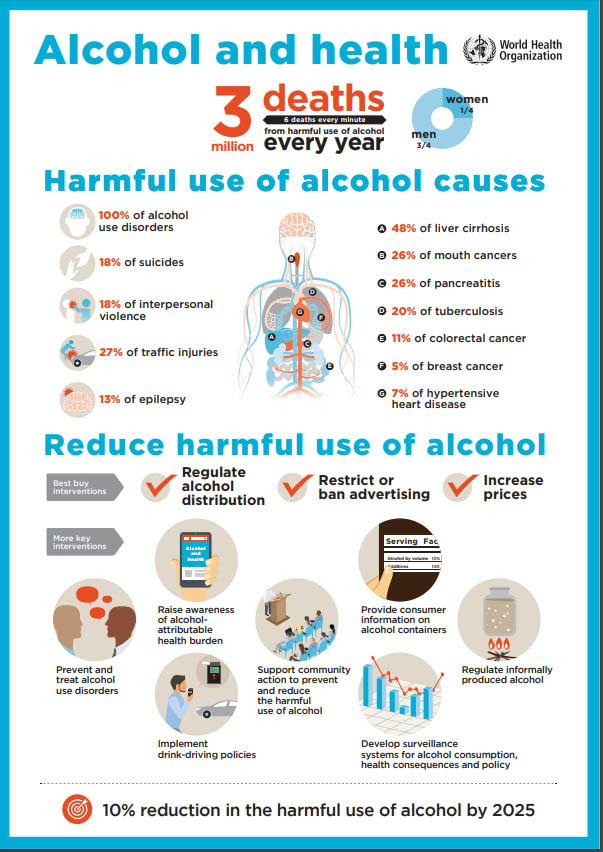
Note. Infographic from the World Health Organization (2014), Global Status Report on Alcohol and Health. The 3.3 million deaths shown in the artwork reflect WHO’s 2014 estimate and have since been superseded: WHO (2024) reports 2.6 million alcohol-attributable deaths per year, or 4.7 percent of all deaths. Reproduced from Introduction to Substance Use Disorders, licensed under CC BY-NC 4.0.
Placing the substances side by side shows how far alcohol use outpaces every other category. Alcohol reaches nearly half the population in a given month, while tobacco, illicit drugs, marijuana, and nicotine vaping each reach a much smaller share. This pattern matters for practice, because the most common substances are not always the ones that receive the most clinical or public attention.
Figure 1.3. Most Commonly Used Substances, Past-Month Use, Persons Aged 12 or Older
| Alcohol |
|
44.4% |
| Any illicit drug |
|
16.4% |
| Tobacco products |
|
16.2% |
| Marijuana |
|
15.1% |
| Nicotine vaping |
|
10.1% |
Note. Original figure created for this text, using data from the Substance Abuse and Mental Health Services Administration (2026), 2025 National Survey on Drug Use and Health. Categories are not mutually exclusive.
Type of Substance: Other Drugs
An estimated 47.5 million individuals, or 16.4 percent of the population, used an illicit drug in the past month based on 2025 NSDUH data. Across the full past year, about 69.8 million people, or 24.0 percent, used an illicit drug (SAMHSA, 2026). Marijuana was by far the most commonly used, with roughly 61.6 million people aged 12 or older, 21.2 percent, reporting past-year use. The next most common were misuse of prescription psychoactive drugs and hallucinogens. Less commonly used were cocaine, methamphetamine, and heroin.
What About Nicotine?
Among persons aged 12 and older, an estimated 46.9 million individuals, or 16.2 percent of the population, used a tobacco product in the past month based on 2025 NSDUH data. An additional 29.3 million people, about 10.1 percent, vaped nicotine in the past month. Nicotine vaping is worth watching closely, because it is the one measure moving against the trend: tobacco use, alcohol use, and binge drinking all declined across the 2023, 2024, and 2025 surveys, while nicotine vaping rose in each of them. According to the WHO, tobacco kills more than 7 million people each year (WHO, 2026, fact sheet updated June 26, 2026).
Type of Substance by Age Group
Based on 2025 NSDUH data, binge drinking and the use of most illicit drugs peaked in the emerging adult group (18–25). More than half of emerging adults who used alcohol in the past month engaged in binge drinking. Marijuana, hallucinogen, and cocaine use were all highest among adults aged 18 to 25, while methamphetamine, heroin, and prescription opioid misuse were most common among adults aged 26 or older.
Table 1.17. Substance Use by Age Group
| Age group | Past-year marijuana use | Past-month tobacco or vaping |
|---|---|---|
| 12 to 17 | 8.7% | 6.9% |
| 18 to 25 | 33.7% | 27.9% |
| 26 or older | 20.6% | 22.9% |
Note. Data from the 2025 National Survey on Drug Use and Health. Substance use generally peaks among young adults aged 18 to 25.
Figure 1.4. Past-Year Illicit Drug Use by Type, Persons Aged 12 or Older
| Marijuana |
|
21.2% |
| Cocaine |
|
1.7% |
| Methamphetamine |
|
0.9% |
| Heroin |
|
0.2% |
Note. Original figure created for this text, using data from the Substance Abuse and Mental Health Services Administration (2026), 2025 National Survey on Drug Use and Health.
Patterns by Gender, Race, and Ethnicity
Substance use is not evenly distributed across the population. Rates differ by gender and by racial and ethnic group, shaped by social and structural conditions rather than by the groups themselves. One concern that cuts across these patterns is prenatal exposure. In the most comprehensive global estimate available, published in 2017, about 10 percent of women worldwide consumed alcohol while pregnant, and that exposure can have lifelong effects on a child’s health, mental health, and development (Popova et al., 2017). The patterns below summarize how use differs across these groups.
Patterns across populations
By gender
Men report higher rates of most substance use and substance use disorders than women. Treatment is a different matter. Among people who have a substance use disorder, men and women receive treatment at nearly the same rate, and that rate is low for both. Figure 1.6 shows the two patterns side by side. The gap in binge drinking among young adults aged 18 to 25 has narrowed in recent years.
By race and ethnicity
Rates of substance use disorder differ across racial and ethnic groups, and the differences are not the same from one substance to the next. Figure 1.5 shows the 2025 figures.
Reading the pattern
People reporting two or more races have the highest overall rate, followed by American Indian or Alaska Native people. Asian people report the lowest rate in every category. Alcohol is the most common disorder in almost every group, but the pattern changes from one substance to another. American Indian or Alaska Native people report the highest stimulant rate of any group, and their alcohol rate is below the national figure. These differences reflect social, economic, and structural conditions rather than anything about the groups themselves, and many of the gaps are small or not statistically significant.
Note. Data from the 2025 National Survey on Drug Use and Health (SAMHSA, 2026). Categories are not mutually exclusive, because a person may meet criteria for more than one substance use disorder.
Figure 1.5. Past-Year Substance Use Disorder by Race and Ethnicity, Persons Aged 12 or Older
Any substance use disorder
| Two or more races | 20.9% | |
| American Indian or Alaska Native | 19.3% | |
| Native Hawaiian or Pacific Islander | 16.6% | |
| Black or African American | 16.3% | |
| Hispanic or Latino | 15.6% | |
| White | 15.6% | |
| Asian | 7.2% | |
| National figure | 15.3% |
By substance
AlcoholCannabisOpioidsStimulants
Two or more races
| Alcohol | 10.7% | |
| Cannabis | 11.3% | |
| Opioids | 1.7% | |
| Stimulants | 2.2% |
American Indian or Alaska Native
| Alcohol | 7.9% | |
| Cannabis | 9.7% | |
| Opioids | 1.9% | |
| Stimulants | 4.7% |
Native Hawaiian or Pacific Islander
| Alcohol | 7.3% | |
| Cannabis | 7.8% | |
| Opioids | not reported | |
| Stimulants | 0.5% |
Black or African American
| Alcohol | 8.6% | |
| Cannabis | 9.2% | |
| Opioids | 1.4% | |
| Stimulants | 1.0% |
Hispanic or Latino
| Alcohol | 9.6% | |
| Cannabis | 6.8% | |
| Opioids | 1.4% | |
| Stimulants | 2.0% |
White
| Alcohol | 9.0% | |
| Cannabis | 6.4% | |
| Opioids | 1.4% | |
| Stimulants | 1.6% |
Asian
| Alcohol | 4.7% | |
| Cannabis | 1.5% | |
| Opioids | 1.1% | |
| Stimulants | 0.6% |
Note. Data from the 2025 National Survey on Drug Use and Health (SAMHSA, 2026). Categories are not mutually exclusive, because a person may meet criteria for more than one substance use disorder. The opioid estimate for Native Hawaiian or Pacific Islander people is not shown because it did not meet the survey’s precision standard.
Show the numbers
| Group | Alcohol | Cannabis | Opioids | Stimulants | Any substance use disorder |
|---|---|---|---|---|---|
| American Indian or Alaska Native | 146,000 (7.9%) | 180,000 (9.7%) | 36,000 (1.9%) | 87,000 (4.7%) | 357,000 (19.3%) |
| Asian | 908,000 (4.7%) | 286,000 (1.5%) | 207,000 (1.1%) | 121,000 (0.6%) | 1,376,000 (7.2%) |
| Black or African American | 2,967,000 (8.6%) | 3,169,000 (9.2%) | 483,000 (1.4%) | 346,000 (1.0%) | 5,636,000 (16.3%) |
| Native Hawaiian or Pacific Islander | 78,000 (7.3%) | 83,000 (7.8%) | — | 6,000 (0.5%) | 177,000 (16.6%) |
| White | 15,183,000 (9.0%) | 10,689,000 (6.4%) | 2,288,000 (1.4%) | 2,627,000 (1.6%) | 26,246,000 (15.6%) |
| Two or more races | 1,014,000 (10.7%) | 1,070,000 (11.3%) | 158,000 (1.7%) | 203,000 (2.2%) | 1,975,000 (20.9%) |
| Hispanic or Latino | 5,451,000 (9.6%) | 3,860,000 (6.8%) | 776,000 (1.4%) | 1,104,000 (2.0%) | 8,809,000 (15.6%) |
| Total, all groups | 25,746,000 (8.9%) | 19,338,000 (6.7%) | 3,972,000 (1.4%) | 4,493,000 (1.5%) | 44,576,000 (15.3%) |
Figure 1.6. Substance Use Disorder and Treatment Among Men and Women, Persons Aged 12 or Older
1. Who has a substance use disorder
Both bars on the same scale, in millions of people aged 12 or older
| Men |
18.1%
|
25.5 million |
| Women |
12.7%
|
19.1 million |
2. Of those, who receives treatment
Each bar is everyone in that group who has a substance use disorder
| Men |
|
10.9% treated · 22.7 million not |
| Women |
|
11.1% treated · 16.9 million not |
The gap is in who has a disorder, not in who gets treated. About 1 in 9 people with a substance use disorder received treatment, in both groups.
Note. Data from the 2025 National Survey on Drug Use and Health (SAMHSA, 2026). Treatment percentages are calculated among people who had a past-year substance use disorder, not among the whole population.
Knowing the scope of substance use is only a starting point. The next section turns to the professionals who respond to it, and to how their roles fit together in practice.
Section 1.2 — Interprofessional Practice in Substance Use Care
Read this section+
Work related to substance use and recovery unfolds across multiple systems, regardless of whether those systems are intentionally coordinated. People experiencing substance-related challenges often encounter professionals from different disciplines within short timeframes, sometimes receiving fragmented or contradictory responses. This course is anchored in social work values, yet it proceeds from the recognition that effective practice depends on collaboration rather than professional isolation. Social work contributes a distinctive focus on person-in-environment, ethical reasoning, and systems navigation, particularly when individuals face barriers shaped by policy or inequality.
Substance use and misuse care must be understood as a complex and evolving area of practice because the problem arises from interactions rather than a single cause or condition. Current patterns of substance misuse reflect a layered reality in which risk develops through the way personal experience intersects with health and access to care. A meaningful response requires a sustained approach that treats substance misuse as a process that unfolds over time and demands continuity in how care is delivered.
A Professional Behavior: Examining Your Own Perspective
Most students arrive in this course already holding views about substance use. Those views are shaped by family and community influences, by religious belief and personal experience, and by what people have absorbed from media and earlier education. Some of them are accurate. Some are not. This course will challenge several of them, and that is intended. A practitioner who has never examined where their beliefs about substance use came from will carry those beliefs into the work, often without noticing, and clients will feel the effect.
Everyone has bias. The goal is not to pretend otherwise but to recognize it and learn to work past it. That means staying open to perspectives that differ from your own, being willing to learn rather than defend, and accepting that the people you serve understand their own lives in ways you may not. Anyone entering a profession that works with people facing substance use issues needs a broader perspective on the topic than common assumptions allow. Building that broader perspective is the core purpose of this textbook.
As you move through this course, expect some of your existing views to be questioned. Stay open, stay willing to learn, and hold your assumptions loosely enough to examine them. That openness is itself a professional skill, and it is where good practice begins.
Foundational Helping and Recovery-Oriented Professions
Social Work Professionals+
Social work practice remains central to substance use and misuse care because it situates treatment within the lived realities that shape risk and recovery. Rather than isolating substance use as an individual pathology, social workers engage it as part of a broader context that includes relationships, environment, and access to resources. Their role involves assessment and diagnosis, as well as treatment planning, counseling, and systems navigation. Through this positioning, social workers often serve as the connective thread across systems, ensuring that care remains responsive to both immediate needs and long-term stability.
Behavioral Health and Counseling Professionals+
Behavioral health professionals deepen the clinical dimension of substance use treatment by focusing on the internal processes that sustain use and influence recovery. Evidence-based approaches such as cognitive behavioral therapy (Magill et al., 2019) and motivational interviewing (Lundahl et al., 2010) have demonstrated effectiveness in reducing substance use and improving engagement in treatment, particularly when co-occurring mental health conditions are present.
Peer Recovery Specialists+
Peer recovery specialists bring lived experience into substance use care in a way that reshapes how individuals engage with treatment. Research indicates that peer support is associated with improved engagement and retention in treatment (Eddie et al., 2019), particularly among individuals who may feel disconnected from traditional service models. By working alongside professionals, peer recovery specialists help bridge the gap between formal systems and lived realities.
Medical and Clinical Treatment Professions
Medical Providers (Physicians, Nurse Practitioners, Physician Assistants)+
Medical providers play a critical role in identifying substance use disorders and managing the physiological aspects of dependence and withdrawal. Their work includes diagnosis, monitoring of health conditions, and the use of medications for opioid use disorder (MOUD), long called medication-assisted treatment, which remain a central evidence-based approach. This role situates medical providers as key contributors to stabilization while also requiring coordination with behavioral and social supports.
Nursing Professionals+
Nurses provide continuity within substance use treatment through their sustained interaction with patients across settings. Their role integrates physical assessment with patient education and ongoing monitoring, enabling early identification of complications and reinforcing treatment engagement.
Pharmacy Professionals+
Pharmacists contribute specialized knowledge that supports safe and effective medication use within substance use treatment. Their role includes monitoring prescriptions, identifying potential misuse, and supporting medications for opioid use disorder by carefully managing dosing and interactions.
Rehabilitative and Functional Support Professions
Occupational Therapy Professionals+
Occupational therapists focus on restoring daily functioning that is often disrupted by substance misuse. Their work emphasizes re-engagement in meaningful activities, which supports the development of structure and purpose within recovery.
Physical Therapy Professionals+
Physical therapists address the relationship between pain and substance use by offering non-pharmacological approaches to pain management. Their interventions support improved function and reduced reliance on opioid medications.
Speech-Language Pathology Professionals+
Speech-language pathologists address cognitive and communication impairments that may result from substance use or overdose-related injury. Their work supports recovery by improving an individual’s ability to process information and engage in treatment.
Care Coordination and Recovery Support Roles
Community Health Workers and Case Managers+
Community health workers and case managers play a critical role in sustaining engagement by addressing barriers that extend beyond clinical care. Their work reflects an understanding that recovery is shaped by access to stable housing, employment, and healthcare.
Faith-Based and Community Organization Leaders+
Faith-based and community organizations provide support within environments that are often more accessible and less stigmatized than formal treatment settings. Their role reflects the importance of belonging and social connection in recovery.
Prevention, Crisis Response, and Systems Interface
Public Health Professionals+
Public health professionals address substance misuse at the population level by identifying trends and implementing prevention strategies. Their work connects data with intervention, ensuring that responses are informed by emerging patterns of use and risk.
Educational and School-Based Professionals+
Educational professionals contribute through early identification and prevention, creating opportunities to intervene before substance use becomes more entrenched. School-based interventions have been shown to reduce risk and improve long-term outcomes when implemented early and consistently.
Emergency Medical Services and First Responders+
Emergency medical personnel provide immediate intervention during overdose events, often determining survival through rapid response and naloxone administration. Their role increasingly includes connecting individuals to care following stabilization.
Criminal Justice Professionals+
Criminal justice professionals, increasingly described in the profession as criminal legal professionals, intersect with substance use through enforcement and diversion efforts that influence access to treatment. Evidence supports the effectiveness of treatment-based approaches within justice settings in reducing recidivism and improving outcomes.
How professionals work together matters, but so does the language they use. The final section examines why the words chosen to describe substance use carry real consequences for the people being described.
Section 1.3 — Professional Language
Read this section+
The language professionals use to describe substance use, and the people affected by it, carries meaning beyond simple description. Words reflect assumptions about responsibility and worth, often shaping decisions in subtle but consequential ways. Research demonstrates that stigmatizing language influences provider attitudes and can affect the quality of care people receive. In this course, attention to language is treated as a core ethical responsibility rather than a matter of etiquette.
Students quickly encounter a range of terms that are often used interchangeably: substance use, substance misuse, addiction, alcoholic, alcohol use disorder, and substance use disorder. These terms are related, but they do not all mean the same thing. Some describe behaviors, others describe patterns of concern, personal identities, or clinical diagnoses. Knowing the difference supports more accurate communication and a clearer understanding of how people experience and describe their relationships with substances.
Table 1.18. Common Terms Used in Substance Use and Misuse
| Term | Definition | Common use |
|---|---|---|
| Substance use | The consumption of alcohol, medications, or other psychoactive substances. Use alone does not imply harm, impairment, or disorder. | Broadest term describing any use of a substance. |
| Substance misuse | The use of a substance in a manner, quantity, or context that increases the risk of harm. | Frequently used in public health, prevention, and educational settings. |
| Problematic substance use | A pattern of use that contributes to negative consequences in a person’s life, relationships, health, employment, or education. | Often used when concerns are present but diagnostic criteria may not be met. |
| Problem drinking | A pattern of alcohol consumption associated with increased risk of physical, psychological, social, legal, or occupational consequences. | Alcohol-specific discussions of risky or harmful use. |
| Addiction | A non-diagnostic term commonly used to describe compulsive substance use despite harmful consequences. | Common in treatment settings, recovery communities, and public discourse. |
| Alcoholic | A non-clinical term traditionally used to describe someone experiencing significant alcohol-related problems. Some embrace it as part of a recovery identity; others view it as stigmatizing. | Common in mutual-aid groups and popular culture; rarely used in professional diagnosis. |
| Substance use disorder (SUD) / Alcohol use disorder (AUD) | Diagnosable conditions defined in the DSM-5-TR by a cluster of cognitive, behavioral, and physiological symptoms indicating continued use despite significant impairment or distress. AUD refers specifically to alcohol; SUD may refer to alcohol or other substances. Severity is classified as mild, moderate, or severe. | Clinical, diagnostic, research, and treatment settings. |
| Recovery | A process of change through which people improve health and wellness, pursue self-directed goals, and work toward their full potential. | Used across treatment, peer support, and recovery-oriented systems of care. |
Note. Original table created for this text; terminology follows Kelly and Westerhoff (2010).
At a broad level, these terms have a general relationship to one another. Substance use is the broadest category and simply refers to consumption. Substance misuse, problematic use, and problem drinking describe patterns that may raise risk or produce negative consequences. Addiction and substance use disorder reflect more significant impairment or distress, though they come from different traditions: addiction is common in recovery communities and public discourse, while substance use disorder and alcohol use disorder are formal clinical diagnoses. Recovery differs from all of these, because it describes a process of growth, healing, and change rather than the presence or absence of a disorder.
Figure 1.7. A General Conceptual Relationship Among Substance-Related Terms
|
Substance Use |
→ |
Substance Misuse / Problematic Use |
→ |
Addiction / SUD / AUD |
→ |
Recovery |
Note. Original figure created for this text.
Read left to right, this shows a general conceptual relationship, not a fixed or required progression.
This relationship is conceptual, not a fixed path. Human experiences rarely follow a neat sequence. Some people use substances without ever developing significant problems. Others move through periods of problematic use, recovery, relapse, and renewed recovery that do not happen in a straight line. Biological, psychological, social, cultural, environmental, and structural factors all shape how a person’s relationship with substances develops over time.
Most importantly, these terms are not labels that define a person. They are descriptive concepts meant to support communication, assessment, treatment planning, research, and understanding. Some people identify as an alcoholic, an addict, or a person in recovery because those terms hold personal meaning. Others prefer language such as person with an alcohol use disorder. Ethical practice means respecting how people understand and describe their own experiences, while recognizing that no diagnosis, behavior, or period of life fully defines who they are.
Supplementary Reading
Stigma Among Health Professionals Toward Patients with Substance Use Disorders
This article emphasizes the importance of confronting personal bias and stigma surrounding substance use and misuse. Failing to examine these attitudes can lead to serious consequences in practice, while addressing them strengthens our ability to work ethically and effectively while treating the individuals we serve with respect.
The Language We Use Is Important
In a 2010 randomized study, mental health clinicians who read a vignette describing a person as “a substance abuser” judged that person as more personally culpable, and more deserving of punishment, than clinicians who read the same vignette describing the person as “having a substance use disorder” (Kelly & Westerhoff, 2010). It is important that alcohol and other drug treatment counselors work to replace disparaging terms such as “abuser,” “addict,” “dirty,” and “clean” with person-first language, such as “person with an alcohol use disorder” (AUD) or “person with a substance use disorder” (SUD).
Begin practicing ways to change the language you use:
| 01Start by identifying stigmatizing labels others use when you read, listen to the radio, watch television, or discuss social work issues in your classes or with friends. |
| 02Think about creative ways to edit what you read or hear to remove labels and describe people in terms of their experiences instead. |
| 03Think about how this might make a difference in how these individuals are viewed and how they might view themselves as a result. |
Labels tend to stereotype, stigmatize, and marginalize people. They also create a pessimistic mindset about the possibility of change. Substance use is a behavior, not a defining characteristic of a person.
Summary
This chapter established the foundation for studying substance use in social work practice. It examined how substances are classified within legal systems and how national and global data reveal the scope of use across populations. It then described the range of professionals who respond to substance use and why their work is interconnected rather than isolated. The chapter closed by examining professional language and personal bias, showing that the words used to describe substance use carry real consequences for the people being described. The classification systems, professional roles, and language practices form the shared vocabulary and professional stance that the rest of the course builds upon.
Key Terms
Show key terms+
Biopsychosocial. A framework that understands substance use through the interaction of biological, psychological, and social factors rather than any single cause.
Controlled Substances Act and drug scheduling. The federal law that sorts drugs into schedules based on their accepted medical use and potential for misuse.
Interprofessional practice. Coordinated work among professionals from different disciplines who share responsibility for a person’s care.
Person-first language. Wording that names the person before the condition, such as a person with a substance use disorder, to avoid defining someone by their use.
Prevalence. The share of a population that uses a substance or meets criteria for a disorder during a given period.
Psychoactive substance. A chemical that affects how the brain functions, influencing mood, perception, thinking, or behavior.
Stigma. Negative judgment attached to substance use that can discourage help-seeking and shape how people are treated.
Substance use disorder. A diagnosable pattern in which recurring use of alcohol or other drugs causes significant impairment in a person’s health, relationships, or responsibilities.
Where This Leads
This chapter built the foundation for the rest of Module 1, establishing how substances are classified, how practitioners work across disciplines, and why the language used to describe substance use carries consequences. Naming a thing is the first step. Explaining it is the next.
Chapter 2 examines the conceptual models of addiction, from early moral judgment through integrated multi-level frameworks. Each model identifies different key characteristics and points toward a different approach to care. Where this chapter supplied the vocabulary, the next one supplies the explanations that vocabulary is used to argue about.
Further Reflection
| Why does the language a practitioner uses to describe substance use matter for the person receiving care, and what changes when that language shifts? |
| How does classifying substances by their effects rather than their legal status change the way risk is understood? |
| What does interprofessional practice make possible in substance use care that a single discipline working alone cannot? |
Attributions
This chapter is an adaptation of “Ch. 1.1,” “Ch. 1.3,” and “Ch. 1.4” in Introduction to Substance Use Disorders by Patricia Stoddard Dare and Audrey Begun, licensed under a Creative Commons Attribution-NonCommercial 4.0 International License. Additional commentary, contextual framing, and instructional modifications have been incorporated to align the material with the objectives and structure of this text.
Bibliography
Show references+
Note: This chapter adapts “Ch. 1.1,” “Ch. 1.3,” and “Ch. 1.4” from Introduction to Substance Use Disorders by Patricia Stoddard Dare and Audrey Begun, licensed under CC BY-NC, and adds original commentary, framing, and sources developed for this text. References drawn from the adapted source and those added here are listed together below.
Begun, A. L., Clapp, J. D., & The Alcohol Misuse Grand Challenge Collective. (2016). Reducing and preventing alcohol misuse and its consequences: A grand challenge for social work. International Journal of Alcohol and Drug Research, 5(2), 73–83. https://doi.org/10.7895/ijadr.v5i2.223
Drug Enforcement Administration, Department of Justice. (2025). Schedules of controlled substances. In Code of Federal Regulations (21 C.F.R. § 1308). U.S. Government Publishing Office. https://www.ecfr.gov/current/title-21/chapter-II/part-1308
Eddie, D., Hoffman, L., Vilsaint, C., Abry, A., Bergman, B., Hoeppner, B., Weinstein, C., & Kelly, J. F. (2019). Lived experience in new models of care for substance use disorder: A systematic review of peer recovery support services and recovery coaching. Frontiers in Psychology, 10, Article 1052. https://doi.org/10.3389/fpsyg.2019.01052
Kelly, J. F., & Westerhoff, C. M. (2010). Does it matter how we refer to individuals with substance-related conditions? A randomized study of two commonly used terms. International Journal of Drug Policy, 21(3), 202–207. https://doi.org/10.1016/j.drugpo.2009.10.010
Lundahl, B. W., Kunz, C., Brownell, C., Tollefson, D., & Burke, B. L. (2010). A meta-analysis of motivational interviewing: Twenty-five years of empirical studies. Research on Social Work Practice, 20(2), 137–160. https://doi.org/10.1177/1049731509347850
Magill, M., Ray, L., Kiluk, B., Hoadley, A., Bernstein, M., Tonigan, J. S., & Carroll, K. (2019). A meta-analysis of cognitive-behavioral therapy for alcohol or other drug use disorders: Treatment efficacy by contrast condition. Journal of Consulting and Clinical Psychology, 87(12), 1093–1105. https://doi.org/10.1037/ccp0000447
Popova, S., Lange, S., Probst, C., Gmel, G., & Rehm, J. (2017). Estimation of national, regional, and global prevalence of alcohol use during pregnancy and fetal alcohol syndrome: A systematic review and meta-analysis. The Lancet Global Health, 5(3), e290–e299. https://doi.org/10.1016/S2214-109X(17)30021-9
Substance Abuse and Mental Health Services Administration. (2026). Key substance use and mental health indicators in the United States: Results from the 2025 National Survey on Drug Use and Health. Center for Behavioral Health Statistics and Quality, Substance Abuse and Mental Health Services Administration. https://www.samhsa.gov/data/report/2025-nsduh-annual-national-report
United Nations Office on Drugs and Crime. (2026). World drug report 2026. United Nations. https://www.unodc.org/unodc/en/data-and-analysis/world-drug-report-2026-highlights.html
World Health Organization. (2014). Global status report on alcohol and health 2014. https://www.who.int/publications/i/item/global-status-report-on-alcohol-and-health-2014
World Health Organization. (2024). Global status report on alcohol and health and treatment of substance use disorders. https://www.who.int/publications/i/item/9789240096745
World Health Organization. (2026). Tobacco [Fact sheet]. https://www.who.int/news-room/fact-sheets/detail/tobacco
