
Chapter 7 – Energy Balance and Obesity
7.3 Assessing Body Weight: What Do the Numbers Mean?
Determining Your Healthy Size

Have you ever stepped on a scale and wondered whether the number really means anything? While body weight can provide useful information, it does not indicate how much of that weight is muscle, fat, bone, or water. In this section, you’ll explore several ways to assess body size and composition and discover why health is about much more than a single number.
Estimating “Ideal” Body Weight
Before BMI calculators and fitness apps became common, health professionals often used simple formulas to estimate a person’s desirable body weight. One of the most widely known is the Hamwi formula, which estimates body weight based on height.
For women, the formula uses 100 pounds for the first 5 feet of height plus 5 pounds for each additional inch. For men, it uses 106 pounds for the first 5 feet plus 6 pounds for each additional inch.
While easy to use, the Hamwi formula does not account for differences in body composition, age, ethnicity, or fitness level. For this reason, it is best viewed as a rough estimate rather than a target weight everyone should strive to achieve.
Body Mass Index (BMI)
BMI is calculated from height and weight using a mathematical formula. Although the calculation can be done manually, most people use online calculators, fitness trackers, or health apps to determine their BMI.[1]
BMI Formulas
- Metric: BMI = weight (kg) ÷ height (m²)
- Imperial: BMI = [weight (lb) ÷ height (in²)] × 703
BMI Weight Status Categories For Adults
BMI values are commonly grouped into categories that help health professionals assess weight status and potential health risks. The categories shown in Table 7.3 are used for most adults aged 20 years and older.
| Weight Status | BMI |
|---|---|
| Underweight | < 18.5 |
| Healthy Weight | 18.5–24.9 |
| Overweight | 25.0–29.9 |
| Obesity Class 1 | 30.0–34.9 |
| Obesity Class 2 | 35.0–39.9 |
| Obesity Class 3 | ≥ 40.0 |
BMI for Children and Teens
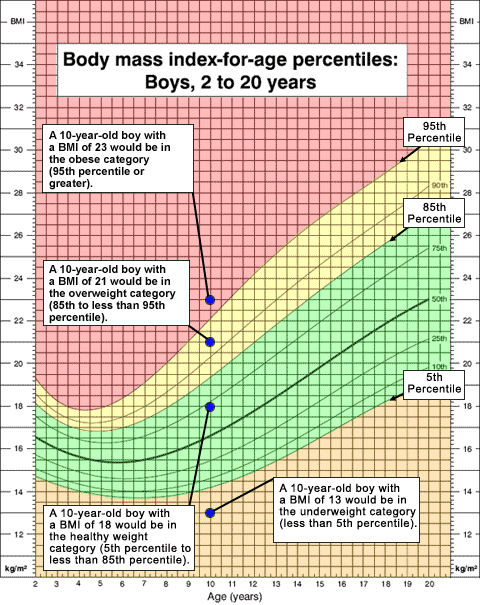
Because children and teens are still growing, BMI is interpreted differently than it is for adults. Body fatness changes with age and differs between boys and girls, so the Centers for Disease Control and Prevention (CDC) recommends using BMI-for-age percentiles for individuals ages 2 through 19 years.
BMI-for-age is determined by calculating BMI and then comparing it to growth charts developed for children and teens of the same age and sex. The CDC provides separate growth charts and online BMI calculators for boys and girls.
The CDC classifies BMI-for-age as:
- Underweight: Less than the 5th percentile
- Healthy weight: 5th percentile to less than the 85th percentile
- Overweight: 85th percentile to less than the 95th percentile
- Obesity: At or above the 95th percentile
Figure 7.11 shows an example of a CDC BMI-for-age growth chart used to assess weight status in children and adolescents. The CDC has a BMI-for-age calculator.
Interpreting BMI
In general, BMI values in the healthy weight range are associated with lower health risks than values in the underweight, overweight, or obesity ranges. Large population studies consistently show that the lowest risk of chronic disease and premature death occurs among adults with BMIs of approximately 20 to 25.
As BMI increases into the overweight and obesity categories, the risk of conditions such as type 2 diabetes, cardiovascular disease, stroke, certain cancers, and osteoarthritis generally increases. However, BMI alone cannot determine an individual’s overall health status.
Limitations of BMI
Although BMI is easy to calculate and widely used, it has several important limitations. Because it is based only on height and weight, BMI cannot distinguish between body fat and muscle mass. As a result, a muscular athlete may be classified as overweight despite having little body fat, while a person with low muscle mass may have a healthy BMI but a higher body fat percentage.
BMI also provides no information about where fat is stored in the body. This is important because abdominal fat is associated with greater health risks than fat stored in the hips and thighs.
In addition, people with the same BMI can have different body compositions. Age, sex, ethnicity, and fitness level all influence the relationship between BMI and body fatness. For example, at the same BMI, women generally have more body fat than men, older adults have more body fat than younger adults, and athletes have less body fat than non-athletes.
For these reasons, BMI is best viewed as a screening tool rather than a diagnostic tool. Health professionals often combine BMI with other measures—such as waist circumference, body composition, blood pressure, blood lipids, and blood glucose—to obtain a more complete picture of health.
BMI is particularly useful for tracking weight trends in individuals and populations over time. However, a single BMI value should never be used alone to define a person’s health.
Measuring Body Composition
A person’s body mass is composed of water, lean body mass (including organs, bone, and muscle), fat, and other components like minerals. The scale does not distinguish among these components, but body composition measurements can.

Techniques used to assess body composition
Techniques Used to Assess Body Composition
Body composition measurements estimate how much of a person’s weight is body fat and how much is lean body mass. These measurements are often used in fitness, healthcare, and research settings. Several methods are available, each with advantages and limitations (Table 7.2).
| Method | Advantages | Limitations |
|---|---|---|
| Skinfold | Inexpensive | Depends on the tester’s skill |
| BIA | Quick and easy | Affected by hydration |
| Bod Pod | More accurate | Expensive |
| DXA | Very accurate | Expensive; radiation exposure |
- Skinfold test. Calipers are used to measure the thickness of skinfolds at several locations on the body. This method is inexpensive, but its accuracy depends on the tester’s skill.

- Bioelectric Impedance Analysis (BIA). BIA estimates body composition by measuring how easily a small electrical current passes through the body. Because hydration affects electrical conductivity, results can vary based on fluid status.

- Air displacement plethysmography (ADP) – This method estimates body composition by measuring the air displaced by the body in a sealed chamber. It is more accurate than BIA but less widely available.

- Dual-energy X-ray absorptiometry (DXA). The method directs two low-dose X-ray beams through the body and measures the energy absorbed. The amount of energy absorbed is dependent on the body’s content of bone, lean tissue mass, and fat mass. Using standard mathematical formulas, fat content and bone density can be accurately estimated. Although this is one of the most accurate methods of measuring fat mass, it is expensive and mostly used in research. It also requires low doses of radiation to the subject being tested, and is not appropriate for pregnant women.

No matter which method is used, body composition measurements are estimates. When tracking changes over time, it is best to use the same method consistently rather than comparing results from different techniques.
Measuring Fat Distribution
Total body fat is one predictor of health, but where fat is stored is also important. People who carry more fat around the abdomen (apple-shaped) generally have a higher risk of chronic diseases such as cardiovascular disease and type 2 diabetes than those who store more fat in the hips and thighs (pear-shaped).
One reason is that visceral fat—the fat that surrounds internal organs—is more metabolically active than subcutaneous fat stored just beneath the skin. Visceral fat releases hormones and inflammatory compounds that may contribute to disease risk.

Body fat distribution can be assessed using simple measurements such as waist circumference and waist-to-hip ratio.
- Waist circumference is measured at the level of the belly button. Health risks increase when waist circumference exceeds 40 inches in men or 35 inches in women.
- Waist-to-hip ratio is calculated by dividing waist circumference by hip circumference. Abdominal obesity is defined by the World Health Organization as a ratio greater than 0.90 in men and 0.85 in women.

Did You Know?
Cellulite is the lumpy or dimpled appearance of skin caused by fat deposits beneath the skin. It is most common in the hips and thighs and affects 80–90% of women. Although many people dislike its appearance, cellulite is harmless and does not indicate poor health.
Indicators of Metabolic Health
Metabolic health refers to the body’s ability to maintain desirable blood pressure, blood lipids, and blood glucose levels. People with obesity are often at increased risk for conditions such as type 2 diabetes and cardiovascular disease. However, not everyone with obesity experiences poor metabolic health. Individuals who meet the criteria for obesity but do not show signs of metabolic disease are sometimes described as having metabolically healthy obesity (MHO).
In contrast, some people have a BMI in the healthy weight range (BMI < 25) but show signs of poor metabolic health. These individuals may be described as having metabolically obese normal weight (MONW). Factors such as poor diet quality, physical inactivity, excess abdominal fat, and genetics may contribute to this increased risk.[2]
These variations challenge the assumptions we often make about body size and health. It cannot always be assumed that thinness equals health or that fatness equals poor health. Body weight can provide useful information, but health cannot be determined by a single number on a scale.
Ultimately, maintaining good health involves much more than achieving a particular weight. Healthy eating patterns, regular physical activity, adequate sleep, stress management, and routine health screenings all contribute to long-term physical and metabolic well-being.
Review Questions
attributions
This section is an adaptation of “Indicators of Health” in Nutrition: Science and Everyday Application, v. 1.0 by Alice Callahan, PhD; Heather Leonard, MEd, RDN; and Tamberly Powell, MS, RDN licensed under a Creative Commons Attribution-NonCommercial 4.0 International License.
- National Heart, Lung, and Blood Institute. Calculate Your BMI. National Institutes of Health. Accessed June 17, 2026. https://www.nhlbi.nih.gov/calculate-your-bmi ↵
- Matthew, H., Farr, O.M., & Mantzoros, S.C. (2016). Metabolic Health and Weight: Understanding metabolically unhealthy normal weight or metabolically healthy obese patients. Metabolism, 65(1), 73-80. doi: 10.1016/j.metabol.2015.10.019 ↵


